
UX/UI, PRODUCT DESIGN // 2026
CUE
Cue is a toxic exposure monitoring system for firefighters, built around a wearable device connected to a mobile app. The device detects hazardous substances inhaled on duty and sends the data to the app in real time, helping firefighters understand their exposure, estimate how long they can safely remain in the area, and make safer decisions in the moment. The app also tracks cumulative exposure throughout a firefighter’s career and connects it with medical records to support long-term health monitoring, helping make invisible danger visible and better protect the people who protect others.
// Was developed as part of a Design Thinking Hackathon in San Fransisco in collaboration with Cornell Tech and UDEM. We worked in a a cross-disciplinary team of designers and engineers.
[DETAILS]
TYPE
UX/UI Product Design
YEAR
2026
PLATFORM
Mobile
TOOLS
Figma, Base44

[THE PROBLEM]
A fire kills twice: once when it burns, again decades later.
In 2025, 72% of firefighters’ line-of-duty deaths were caused by occupational cancer. Toxic wildfire smoke has been linked to a 1.9× higher risk of lung cancer, yet one of the biggest threats firefighters face, air toxicity, still remains largely untracked. Without real-time and long-term exposure data, firefighters are left vulnerable to invisible risks that can affect them years after the fire is over.
[THE SOLUTION]
Every Breath Monitored, Every Firefighter Protected
Cue is a real-time toxic exposure monitoring system designed to protect firefighters from the invisible dangers they face on duty. A wearable device detects hazardous substances inhaled during active incidents and sends that data to a connected app, where firefighters can monitor exposure levels, estimate how long they can safely remain in a contaminated area, and make safer decisions in real time. Beyond immediate response, Cue tracks cumulative exposure across a firefighter’s career and connects it with medical records to support long-term health monitoring and earlier intervention. By turning invisible danger into actionable data, Cue helps protect the people who protect others.

[HOW MIGHT WE]
HMW make invisible toxic exposure visible and actionable for firefighters in real time?
[MAIN FLOWS]

[REAL TIME EXPOSURE]
[LONF TERM EXPOSURE DATA]
[PERSONA]

Jeff Tomzak
Occupation: Deputy Chief & Firefighter
Jeff is an experienced firefighter who regularly works in high-risk environments where smoke and airborne toxins are part of the job. While the immediate danger of fire is always visible, the long-term impact of repeated toxic exposure is much harder to track. He wants clearer, real-time information that can help him stay safe in the field and better protect his health over the course of his career.

[THE PROCESS]
Reseach and ideation
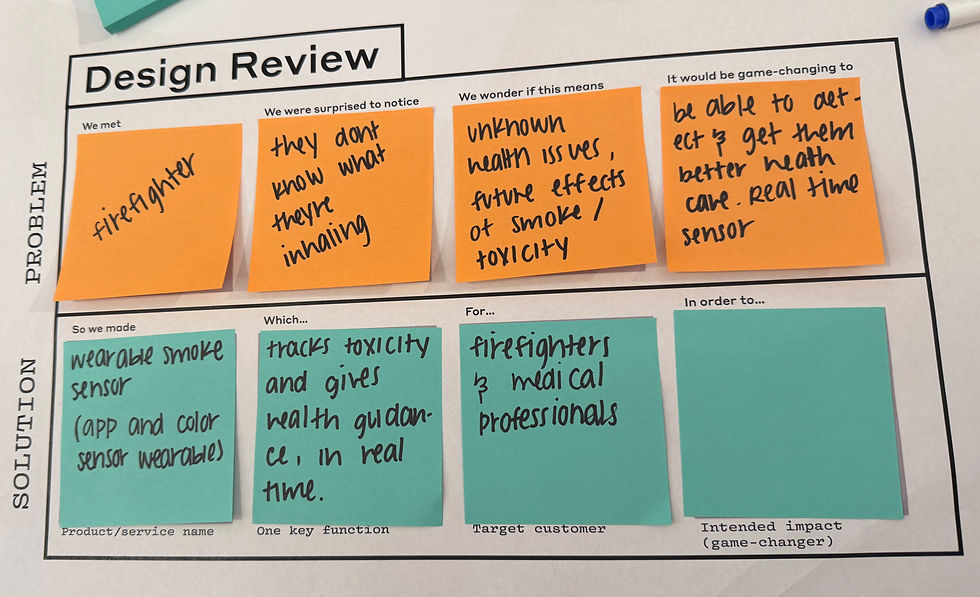
The project began during a Design Thinking Hackathon in San Francisco, held in collaboration with Cornell Tech and UDEM. Working in a cross-disciplinary team of designers and engineers, we focused on a critical but often invisible issue: the long-term health impact of toxic exposure on firefighters.
Research and Validation in Stanford University
To ground the concept in real-world medical and environmental concerns, we consulted with Mark Leone, a specialist from Stanford University.
This helped us better understand the risks of toxic inhalation, the gaps in current monitoring methods, and the kind of data that could be most meaningful for firefighters in both the short and long term.
Developing the concept
As part of the ideation process, we also took part in sessions connected to the design school at Stanford University, where the concept was further developed and challenged. These sessions helped us sharpen the opportunity, define the role of the wearable device and app, and shape the product into a more focused and actionable system.
Translating insight into product
Using the research, expert input, and ideation outcomes, I translated the problem into a connected solution: a wearable toxic monitoring device paired with an app for real-time exposure visibility, safe-time guidance, and long-term health tracking. In parallel, I reviewed existing products and UX patterns to better understand how systems for health, safety, and live monitoring communicate complex data clearly, build trust, and support quick decision-making in high-pressure environments.
Outcome
Cue translated an invisible and complex health risk into a clear product experience. By designing for both immediate response and long-term monitoring, the project turned exposure data into something actionable, understandable, and relevant over time. The result was a system built to support clarity under pressure, strengthen health awareness, and create a stronger connection between field conditions and long-term care.


© 2026 MAYA SEGAL