UX/UI, PRODUCT DESIGN // 2025
SUBBY
A mobile and desktop app for short-term car sublets, connecting owners and drivers with flexible scheduling, verified profiles, and secure bookings. Designed across the full product cycle, including research, UX flows, responsive UI, and interactive prototypes.
[DETAILS]
TYPE
UX/UI Product Design
YEAR
2025
PLATFORM
Mobile and Desktop
TOOLS
Figma

[THE PROBLEM]
People struggle to access a car only when they actually need one, without taking on the cost and complexity of ownership.
While exploring the mobility habits of people living in dense urban areas, it became clear that many only need a car for short, specific periods, a few hours or a day or two, yet existing solutions often feel too expensive, inconvenient, or inflexible for that kind of use.
[THE SOLUTION]
A trusted car sublet app for flexible, secure rentals, powered by smart tools and mutual trust.
Subby enables short-term car rentals between private owners and drivers through a simple, safe, and efficient experience. With verified profiles, mutual approval, ratings, and smart tools for scanning, documentation, pickup, and return. Subby+ gives you exclusive perks, partner benefits, and more flexible returns.
[HOW MIGHT WE]
Create a trusted and seamless way for people to access short-term car sublets, while helping car owners turn an idle vehicle into value?
[MAIN SCREENS]

[PERSONA]

Geffen Ahornson
Age: 26
Location: Tel Aviv
Occupation: Architecture student
[PAIN POINTS]
- Short-term rentals can feel expensive and inconvenient
- Public transport does not always fit her schedule
- Trust and safety are major concerns
[GOALS]
- Access a car only when needed
- Avoid the burden of ownership
- Take and return the car easily
[USER STORIES]
As a driver, I want to book a car for a few hours or days, so that I only use a car when I actually need one.
As a driver, I want to review profiles, ratings, and car details, so that I can feel safe before booking.
As a car owner, I want to choose who rents my car and when, so that I stay in control.
As a car owner, I want to earn from my car when it is not in use, so that it becomes a valuable asset instead of an ongoing expense.
[FINAL PRODUCT]

[THE PROCESS]
Understanding the problem
I explored the mobility gap from both sides: people who need a car occasionally, and owners whose cars sit unused most of the time. I also reviewed current alternatives like rental companies, borrowing, and peer-to-peer solutions to identify gaps in flexibility, trust, and convenience.
Researching competitors
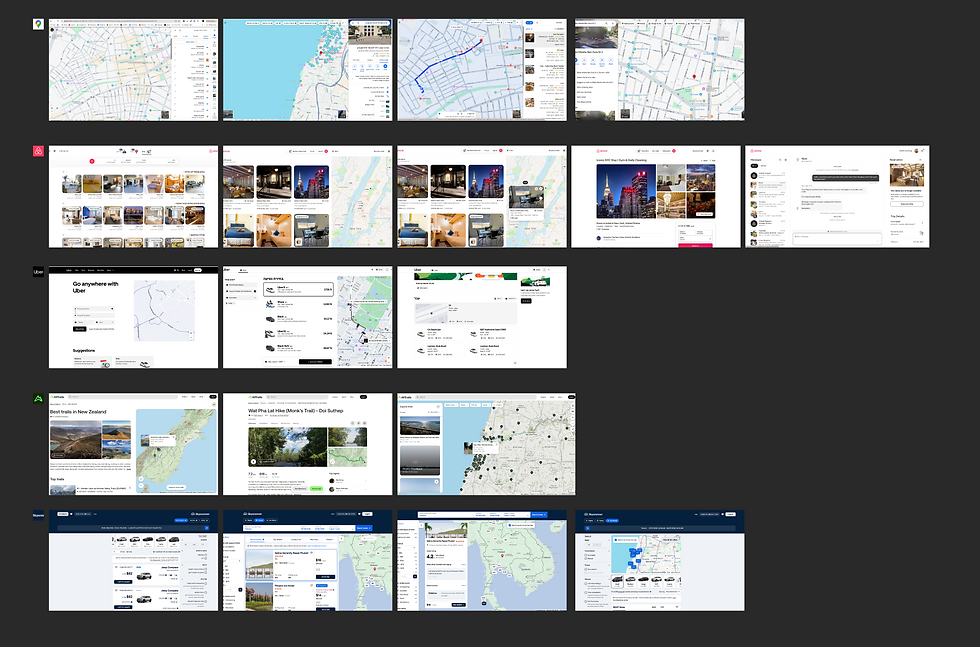
I analyzed existing products across car rentals, navigation, marketplaces, and peer-to-peer platforms to understand common flows, familiar patterns, and opportunities for improvement.
Mapping user needs
Through interviews and early research, I mapped the main needs of drivers and car owners, focusing on trust, safety, flexibility, ease of coordination, and clarity around pickup and return.
Exploring UX/UI patterns
I studied familiar apps like Google Maps, Uber, Grab, Airbnb, Booking, Lime, Bird, Lemonade, and Tinder to identify patterns for maps, listings, reviews, trust signals, guided flows, and profile-based matching. This helped shape both the UX structure and visual direction of the product.
Outcome
Subby translates an urban mobility problem into a product opportunity built around trust, flexibility, and shared value. The project helped define a service that balances the needs of both drivers and car owners while turning complex coordination points into simple, guided interactions.